
The Real Cost of Hiring a Mechanical Engineer (It’s Not $50 an Hour)
“Why would I hire a consultant engineer for $150 an hour when I could hire an in-house mechanical engineer for $50 an hour?” This is a question we get regularly at Catalyst Engineering. At a surface level, the question makes sense: on paper, why are you spending three times the amount to bring in a consultant when an in-house hire could do the same work?
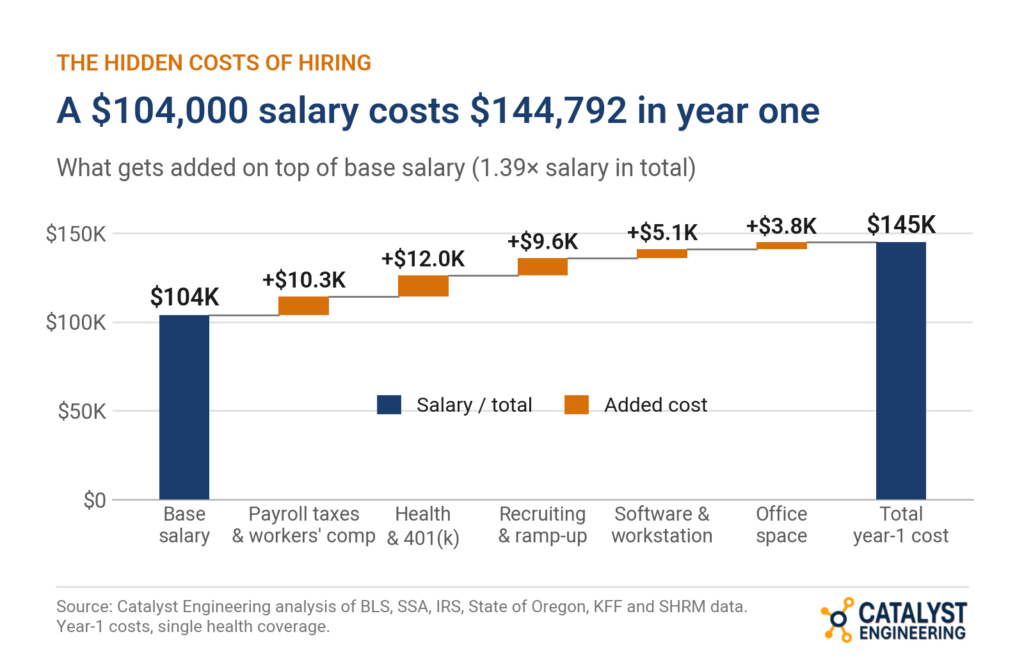
But those two numbers don’t tell the whole story. The $50 figure, the median hourly wage for a mechanical engineer according to the U.S. Bureau of Labor Statistics, covers only about 70% of what it costs to employ one. It also assumes every hour you pay for is a productive one.
The Hidden Costs on the Payroll (the Fully Burdened Rate)
Once you account for the costs that show up on payroll. Once you account for employer payroll tax, state programs, workers’ comp insurance, health, dental, vision, retirement matching, PTO, and holiday pay, the numbers go up significantly from the median salary of $104,000 a year. Joe Hadzima, a senior lecturer at MIT’s Sloan School of Management, offers a back-of-the-napkin rule: salary + taxes + benefits typically come to 1.25–1.4× base salary. This means that for the average mechanical engineer, the on-paper cost of employment is between $130,000 and $145,600 per year.
The Detailed Breakdown
Using current employer cost data from the SSA, the IRS, the state of Oregon, as well as some assumed costs for workers’ comp and 401(k) matching, we can build out a detailed estimate of the full cost of compensation for an engineer. We can further expand on that idea, including costs for a workstation, CAD license, recruiting, ramp-up, and office space.
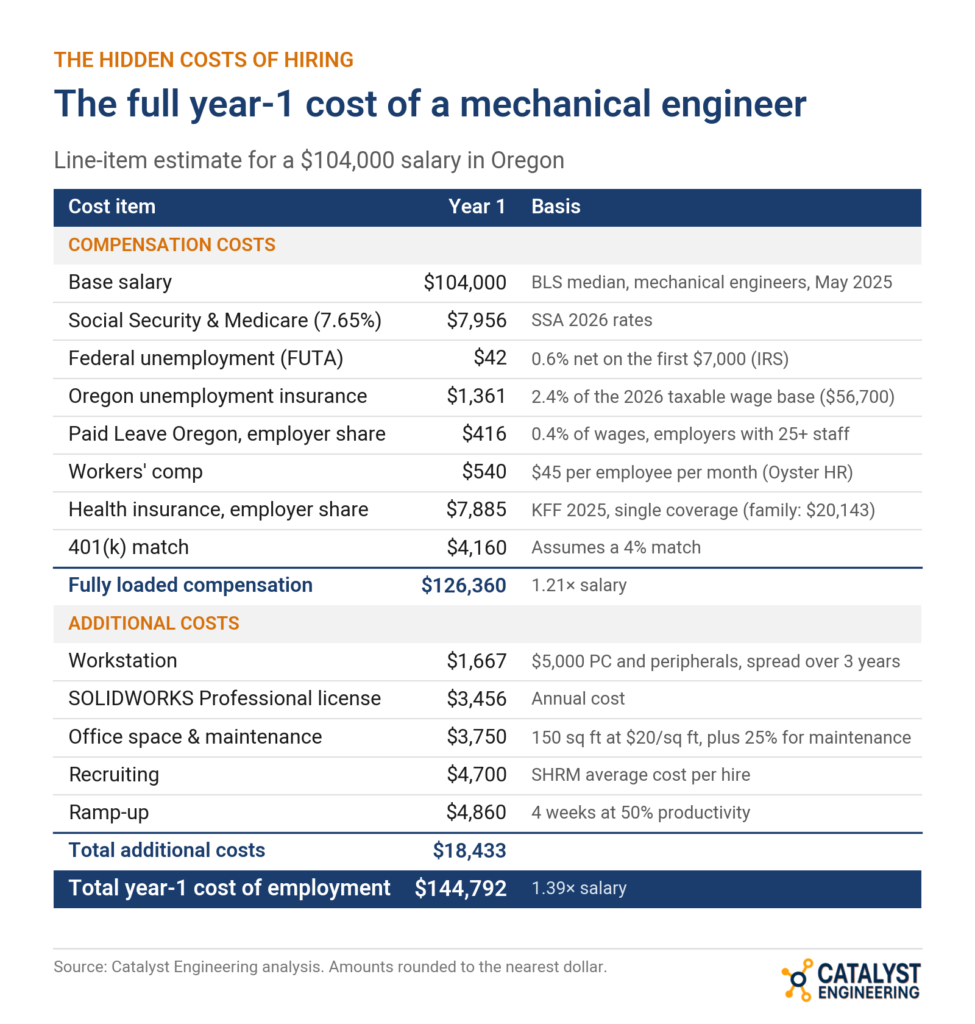
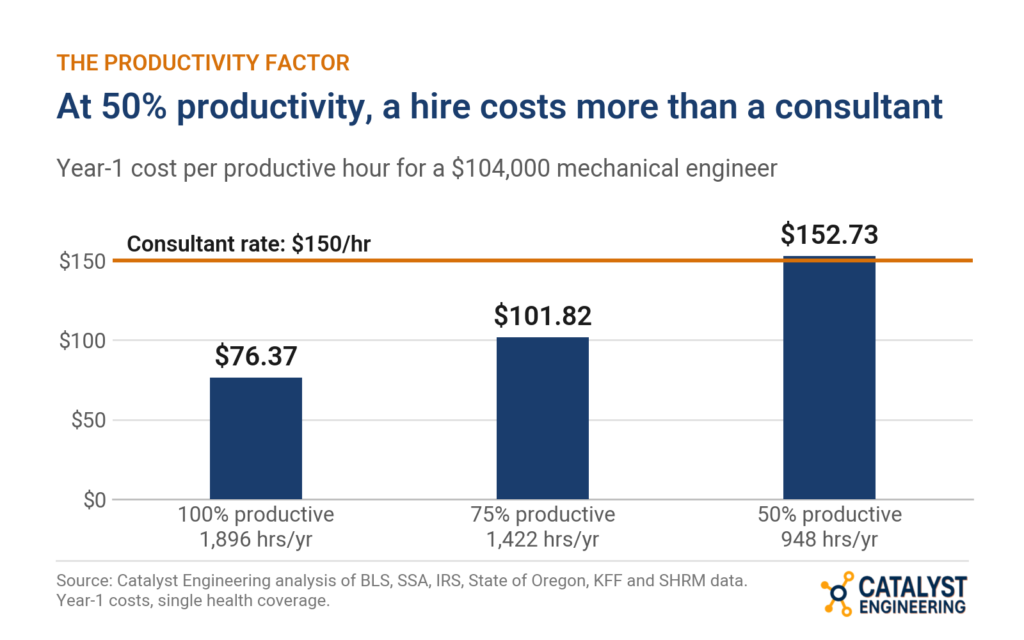
Once we factor in productivity time, the numbers begin to tell a very interesting story. Assuming 1,896 working hours a year (2,080 minus 8 holidays and 15 PTO days) and an employee who is productive 100% of that time, the true cost climbs to $76.37 per hour.
What Role Does Productivity Play?
As productivity approaches a more realistic 75%, the cost per productive hour climbs to over $100/hour. At the low end, with 50% productivity, the cost per productive hour climbs to over $150.
With a consulting engineering firm like Catalyst Engineering, this productivity factor becomes a non-issue. You hire us when you need us, for as long or as short as you need us, and the moment you don’t, we leave. Furthermore, we only charge you for our productive time; if we step away to take a phone call, the clock stops.
Why Do Consultants Cost So Much?
Consulting engineering firms carry all the same costs that companies looking to hire a full-time engineer do. At Catalyst, for example, we have our own workstations, our own SolidWorks licenses, and the same HR costs. Our rate covers those costs, and you only pay for the hours we spend on your project.
When to Hire a Consultant Vs. When to Hire Full Time
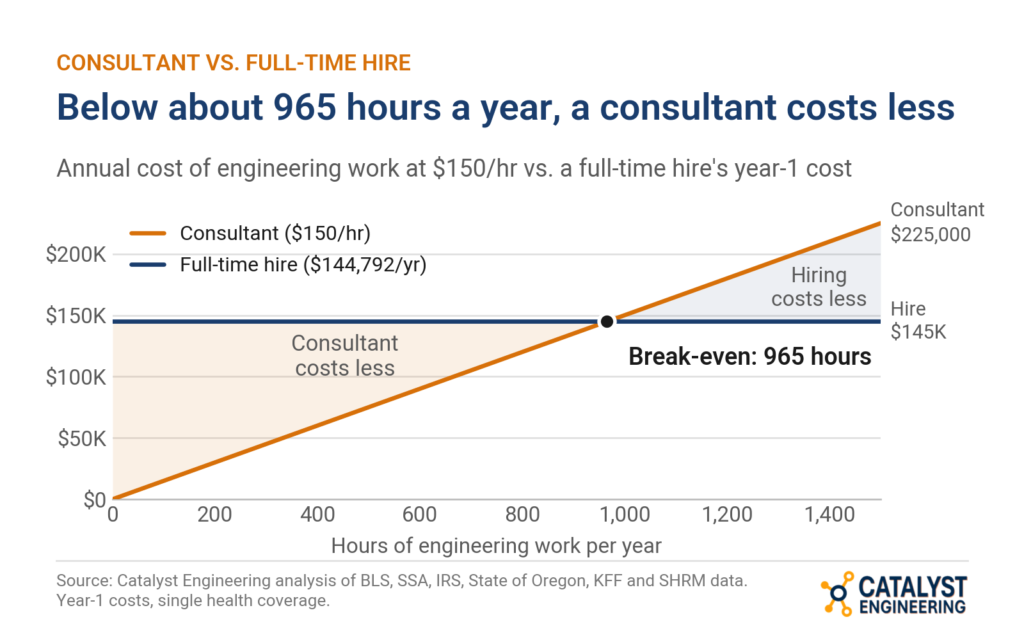
While there are many advantages to hiring a consultant, it isn’t the right call for every situation. Using the numbers above, a full-time engineer costs about $144,800 in the first year, whether you have work for them or not. At $150 an hour (a typical consulting engineer rate), that same money buys about 965 hours of consulting time, roughly half of a full-time workload. If you have less than about 965 hours of engineering work a year, or if your work comes in waves, a consultant is the more affordable option. If you have steady, year-round work well above that, adding an engineer to payroll makes sense. And these are conservative numbers: with family health coverage instead of individual coverage, the break-even rises to about 1,050 hours.
What the Contract Model Gets You Beyond Cost
So, what are the benefits of the contract model? We’ve outlined the financial upsides, but what do you get for your money? Contract services are on an as-needed basis. Instead of taking weeks or months to find a candidate, once you send an inquiry to us, we get back to you quickly, usually within a day. From there, we get you a quote, and an engineer can be on your project within a couple of days.
Consultants can work remotely or on site, giving you the flexibility to get help the way you need. Our engineers are equipped with their own workstations and software packages, meaning we can work remotely, without taking up space or workstations.
Catalyst also brings tools most companies can’t justify owning. In-house, we offer services such as laser scanning and 3D printing, along with software packages like SolidWorks Simulation, SolidWorks Visualize, and SolidWorks Flow Simulation, as well as architectural software like Revit. Because we work with clients across many industries, we keep these tools current and our engineers trained on them. If a short project needs a scan, a stress analysis, or a quick prototype, you don’t have to buy equipment or licenses you’ll rarely use. Our engineers bring both the tools and the expertise to use them.
Our team is made up of engineers in multiple disciplines, from mechanical to electrical and control systems. We also have as-needed PE resources, supplying you with stamped drawings when you need them. We don’t require long-term contracts and have flexible contract terms, with no layoffs when the project ends. See our article on surge engineering capacity to learn how we can help clear your backlog.
The Bottom Line
Don’t compare a consultant’s hourly rate to a salary divided by 2,080. Compare what an employee costs to the engineering hours you have. If that’s less than about 1,000 hours a year, or your work comes in waves, a consultant is likely the better deal. Send us your backlog, and we’ll give you a quote you can put side by side with a new hire.
References
1. U.S. Bureau of Labor Statistics. “Mechanical Engineers.” Occupational Outlook Handbook (May 2025 wage data).
https://www.bls.gov/ooh/architecture-and-engineering/mechanical-engineers.htm
2. U.S. Bureau of Labor Statistics. “Employer Costs for Employee Compensation – June 2026,” Table 4 (released September 9, 2026).
https://www.bls.gov/news.release/ecec.t04.htm
3. Hadzima, Joe. “How Much Does an Employee Cost?” Starting Up: Practical Advice for Entrepreneurs, MIT.
https://nutsandbolts.mit.edu/BBJ/EmployeeCost.php
4. Social Security Administration. “Contribution and Benefit Base” (2026 rates).
https://www.ssa.gov/oact/cola/cbb.html
5. Internal Revenue Service. “Topic No. 759, Form 940 – Employer’s Annual Federal Unemployment (FUTA) Tax Return.”
https://www.irs.gov/taxtopics/tc759
6. Oregon Employment Department. “Payroll Taxes and Contributions.”
https://www.oregon.gov/employ/Businesses/Pages/Contributions.aspx
7. Paid Leave Oregon. “Employers.”
https://paidleave.oregon.gov/employers/
8. Oyster HR. “How Much Does Workers’ Compensation Insurance Cost?” (updated August 2026).
https://www.oysterhr.com/library/workers-compensation-insurance-cost
9. KFF. “2025 Employer Health Benefits Survey.”
https://www.kff.org/health-costs/report/2025-employer-health-benefits-survey/
10. SHRM. “The Real Costs of Recruitment” (2022).
https://www.shrm.org/topics-tools/news/talent-acquisition/real-costs-recruitment